Corresponding with writers and bibliophiles about what we've been reading lately.
Nicholas Naioti is a multimedia artist in Kirksville, Missouri. His artist focus is to cultivate minimalist, approachable concepts in a way that instigates nostalgia and a sense of wonder. He's been making music and art for 20 years and has released over a dozen albums with different projects.
Nate: I'm
loving your new album Hunker Down, it's a real beauty. I'm
interested in the artistic choices you made in producing this one, you wrote
that "the songs materialized as a flow of consciousness, were recorded and
mixed with the first possible takes, and took on a life of their own as an
album." What motivated that approach? How does that compare to your
process on previous albums?
Nicholas: Typically, I think
of albums I'm releasing as these big statements that are going to have such an
impact on my place in the world and how others view me. This time, I tried to
reduce the scope of the project's place in my mind. I wanted to make something
quick that sounds like me and get it out. I'm starting to resonate more and
more with this mode of working. For me the fun part is the creation. But
sometimes the capitalist expectation of what art is can corrupt that. 'If I
pick up my guitar, then I have to write a song, then I have to record it and
deliberate over it for months, then release it and package it and try to
convince people to buy it.' This is how my mind works. If I can just relax into
it and take each step on my own terms, it stays fun. And I actually think the
end product benefits from it. It sounds more human. That was the mindset behind
this album.

Nate: The end result is still really well-thought out and crafted, though; this doesn't sound like demos at all. I'm curious about how your lyrics came together so well on the album. For example, there's a song on here that I found particularly striking called "I See It" with these lovely verses where you're weaving images from the natural world, domestic sphere, and inner life together to show a vision of love - seeing love. How did that song come together? Nicholas: I wrote that one quickly, in an
afternoon. Most artists I know have experienced this: some works take months of
effort to shape into something you feel good about, and some just spill out as
a fully realized piece in an instant.
After
my son Luca was born, I was extra weepy for a few months. Maybe some kind of
hormonal shift? Songs were hitting me harder, I was dialed into the budding
flowers, the dying leaves - it's like the contrast was turned way up on my
perception of the world. Everything was more beautiful and intense. I was able
to see and appreciate the creativity in all organic matter. That idea was the
influence for this song, though I wasn't trying to write a song about that when
I started. It just happened, and I didn't censor it.
Nate: How does that
compare to your composition of ambient and instrumental music, like on your previous
album The Fragrance?
Nicholas: I have a
fondness for music that doesn't require your attention. Brian Eno talks about
ambient music as a tool - it can be used for meditation, for work, for whatever
you need it to be. With both my ambient albums, I encourage people not to listen
to it with intention necessarily. Just put it on as background music
while you're making breakfast or whatever! I think that's cool. It's like
service work.
To
answer your question, I just really enjoy it. Composition gets complicated when
I have to write words. I get hung up on their meanings and overthink how they
could be perceived. It's relaxing and easy to make ambient music. I love doing
it and people seem to respond to it. I could see myself shifting to making
instrumental music exclusively. There's less pressure.
Nate: I wouldn't have guessed that
you get hung up on words when writing lyrics, I've always found
your lyrics to be very poetic but also naturalistic, I feel like I'm listening
to you thinking. Who are some lyricists that inspire you?
Nicholas:
I tend to hear the music before I hear the words. I find it annoying when the
words are too loud or too attention-grabbing in music. The lyricists that I've
been loving lately are Vashti Bunyan, Jonathan Richman, Leonard Cohen, Bob
Dylan, Phil Elverum, John Darnielle, and of course the great one, Joni
Mitchell. All of these people have vastly different styles, but I've taken
little bits of inspiration from all of them. Making an interesting collage of
these broad influences is what I'm trying to do, I guess!
Nate:
How about certain authors that make you feel like writing?
Nicholas: Lately I've been gravitating towards
graphic novels. I'm a big Alison Bechdel fan and her newest book, The Secret to Superhuman Strength is my favorite of hers. It's a sprawling, tangential
memoir about her relationship to fitness and its psychological relationship to
aging. It's so good! I'm reading it slowly, savoring it.

I also just finished
reading another graphic novel called How to Completely Lose Your Mind by
Elizabeth Jancewicz and Eric Stevenson. They have a band called Pocket Vinyl and they're one of these perma-tour DIY bands. You know the type. They
wrote a novel about touring, specifically their attempt to break the world
record for playing a show in every U.S. state in the shortest length of time.
It's amazing. You need to read this! It's an incredible story, plus a great
primer for anyone curious about the subject. It's very approachable to any
casual reader while also being super relatable to those of us that have done a
DIY tour before. The art is really distinct and stylized and the writing is
emotional and effectively potent while still being light and funny.

I'm also reading The Creative Act by Rick Rubin. It's a great self-help book for any creative
type. There's a ton of wisdom in there and every time I sit down to read it, I
want to put the book down and run to my studio to work on music. It reminds me
of one of my favorite books of all time, The Artist's Way by Julia Cameron. I recommend this book to all my creative friends, and I've purchased
probably ten copies of it to give away. There's so much power in the pages of
this book. I credit it for pushing me to create and release more music, and it
helped me realize that I could make more money with my DJ career. It's not for
everyone; it's pretty dated and if you aren't able to just ignore some sections
of it, it's going to be annoying at times. It's a 'take what you need and leave
the rest' kind of situation. It prompts you to write three pages every morning,
so that's the book that's gotten me writing the most. That might sound
daunting, but once you make it a habit it becomes easy and enjoyable.

Nate: I'll
definitely check out How To Completely Lose Your Mind, thanks for
the recommendation! Yeah that immense but hidden world of underground music
does seem like a ripe topic for a graphic novel. Did you recognize any bands or
venues in the book from your own many DIY tours?
Nicholas: I didn't recognize
many venues or bands, but I did recognize lots of familiar situations. Showing
up to a place where you're supposed to be sleeping and nobody will answer the
door, bizarre but harmless conversations with maladjusted people at shows, playing
a show to nobody just because, showing up to a venue where you've confirmed a
show and it's inexplicably closed - classic DIY touring stuff! Although these
situations might seem negative, I look back fondly on those memories. Novelty!
One of the members of Pocket Vinyl is female so it's illuminating to see these
experiences from that perspective. Can't recommend that book enough, even if
you don't have experience in DIY music. It's a joyful read.
What about you? What have
you been reading?
Nate: I've been reading pretty widely. Since you brought up graphic novels,
I'll mention one I read (or, in this case, practically watched) a while back
called One Beautiful Spring Day by Jim Woodring. Our mutual
friend Bryon Dudley recommended this one to me. It's a very psychedelic,
mesmerizing black-and-white book with no text, it's all visual. Since you're
not really pausing on a panel to read language your eye just keeps scanning the
imagery and it has almost a flip-book effect suggestive of a moving image.
Which is especially fitting in this case because the work has an aesthetic
reminiscent of '30s cartoons; the style and sense of humor reminded me a bit of
the Fleischer Brothers, for instance. The intimation of motion is enhanced by
Woodring's tendency to draw pervasive wavy lines that can generate an optical
illusion: if you focus your eye on a single point, the lines in your peripheral
vision seem to jump around. So overall it's a bouncy, mobile
"reading" experience considering that the book itself is a static
object.
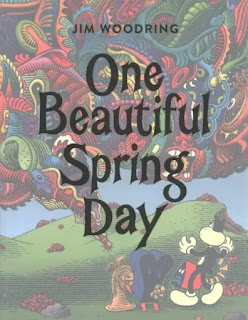
The story is a dreamlike series of bizarre adventures in which a
protagonist named Frank (some kind of indeterminate cartoon animal walking
upright) encounters strange creatures who present him with various vessels that
act like portals through worlds-within-worlds. The novel is actually a
compilation of a series of books about Frank that Woodring has been drawing for
over thirty years, One Beautiful Spring Day is the culmination
and collection of the stories, presented as a continuous visual experience
whose 400+ pages can be witnessed in a single sitting. Personally, I couldn't
look away, I was transfixed.


